
On Bricks, Bonds, and Belonging: Material and Relational Theories of the Commons
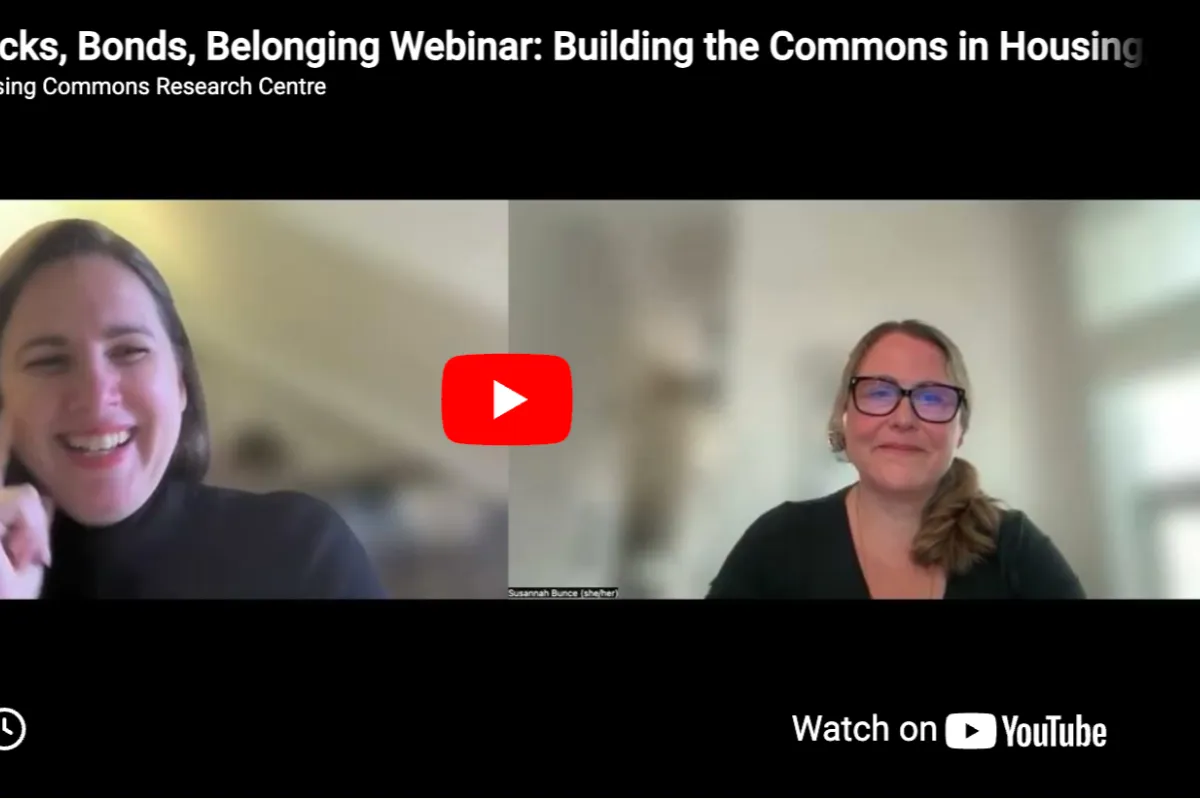
On April 16, the Housing Commons Research Centre hosted Bricks, Bonds, Belonging, a timely conversation exploring what it actually means to build the commons within a housing system shaped by private property, financialization, and individual ownership.
Featuring Susannah Bunce and Karen Kubey, the session moved beyond abstract definitions to examine how the commons is materialized—and challenged—across design, policy, and everyday life.
The discussion unfolded across two complementary lenses. Karen Kubey grounded the conversation in the realities of architecture and housing design, reflecting on how intentions around collectivity often collide with financing structures, zoning constraints, and institutional norms. Her presentation highlighted the gap between designing for shared life and delivering it in practice, raising important questions about when—and whether—design can meaningfully support the commons.
Susannah Bunce shifted the focus to the relational dimensions of the commons: the care work, governance structures, and social infrastructure required to sustain collective living. She emphasized that the commons is not just a spatial or legal arrangement, but an ongoing process of “commoning”—one that relies on labour, negotiation, and often unevenly distributed responsibilities shaped by race, class, gender, and tenure.
Together, the speakers engaged in a candid dialogue about where ideas of the commons “get stuck.” From the limits of policy frameworks to the challenges of scaling community-led models, the conversation surfaced a central tension: while the commons is widely invoked in housing discourse, its practical realization remains constrained by the very systems it seeks to transform.
Audience questions further grounded the discussion, drawing connections to on-the-ground experiences and prompting reflections on small but meaningful interventions—from design decisions to policy shifts—that can redistribute power and support more collective forms of living.
The session closed with a shared recognition that the commons is neither a fixed model nor a simple solution. Instead, it is a contested and evolving practice—one that must be continuously built, governed, and sustained across both material and relational dimensions.
As HCRC continues to convene conversations like this, Bricks, Bonds, Belonging underscored the importance of creating space not just to define the commons, but to critically examine how—and where—it can take root in practice.